
Home > Shipwreck Blogs > Liefde Shipwreck Gold: The Rarest VOC Shipwreck Ducats

During the 17th and 18th centuries, the Dutch East India Company (VOC) transported a diverse array of coins on their ships, including German thalers, Spanish Netherlands ducatons, Spanish colonial reales, and various Dutch Republic coins. Initially, Spanish reales dominated Asian trade, but around 1630, Dutch trade coins gained prominence. These included leeuwendaalders, rijksdaalders, and dukatons. By the late 17th century, the VOC also began shipping large quantities of “payement”, which was a collective term for 6, 2, and 1 stuiver coins minted in the Dutch Republic. Shipwrecks like the Merestein and Zuytdorp have yielded significant quantities of these coins.
Although being shipped on a far smaller scale, the VOC also transported gold coins, particularly in the form of gold ducats that were minted in the Dutch Republic. In the 17th century, this happened in modest quantities, in the 18th century to a somewhat greater extent. Most of these were intended for recoining in South Indian mints, but some of the ducats also came into circulation in the Archipelago and Ceylon. As ducats were only shipped in small quantities, relatively few VOC shipwrecks have ever been discovered that yielded those gold coins.
So far, only three VOC shipwrecks have ever been recovered that yielded gold ducats, with the Akerendam and the Vliegenthart being the most famous among collectors. Respectively, more than 6700 gold ducats were retrieved from the Akerendam shipwreck, most of them being rare Dutch ducats minted in Utrecht in 1724. The Vliegenthart wreck yielded around 5100 gold ducats dated 1729, which were minted in the provinces of Holland, Utrecht and West-Friesland. They were unique in that they never entered circulation and generally remained in pristine condition.
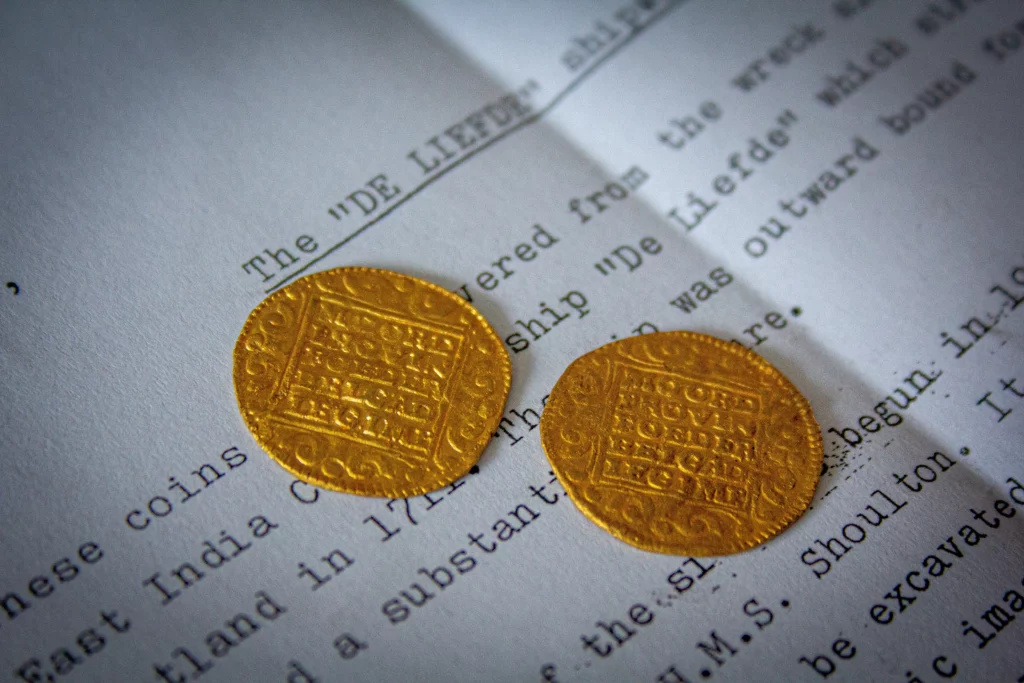
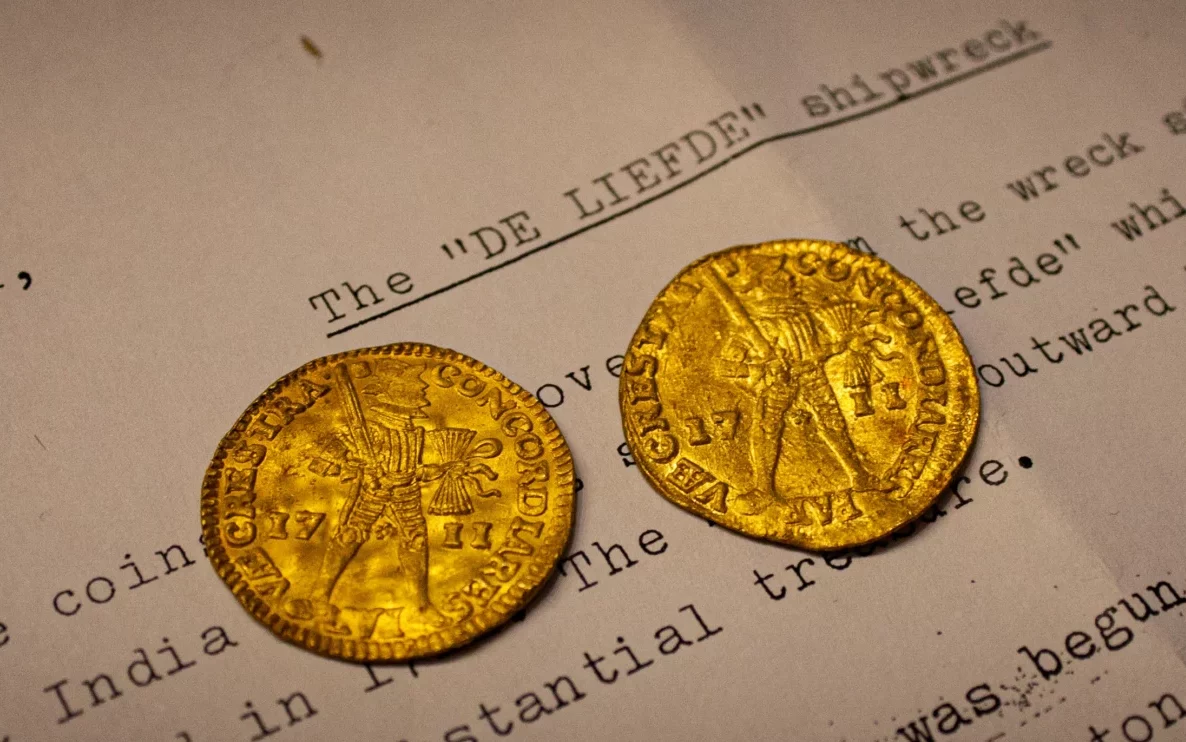
The rarest gold ducats were recovered from the Liefde shipwreck, that carried a freshly minted consignment of 1711 Utrecht gold ducats. It is not exactly known how many gold ducats were retrieved from the Liefde wrecksite since its discovery in 1964, but estimates only range in the couple of hundreds. This uncertainty can be attributed to early salvage attempts by locals who found an undocumented number of coins after the ship’s sinking. Additionally, Dutch diving expeditions between 1729 and 1735 also recovered an unknown quantity of coins, which further complicates efforts to determine the total number of ducats originally aboard and subsequently retrieved from the Liefde wrecksite.
Despite being small in number, Liefde ducats generally show some typical characteristics (with some clear exceptions), including wavy flans, slight bending, and rough, damaged surfaces caused by the challenging underwater terrain and prolonged maritime environment. However, the ducats still show uncirculated details, as they were newly minted when they were carried aboard the merchant. Given their scarcity, history and condition Liefde ducats remain among the most sought-after and valuable VOC shipwreck coins.
@wrecktreasure The sinking of the VOC merchant “De Liefde” #dutcheastindiacompany #voc #deliefde #shipwreck #treasure #history #pirate #fyp #foryou ♬ origineel geluid - wrecktreasure