
Home > Shipwreck Blogs > The Freshly Minted “Payement” Coins Recovered From VOC Shipwrecks
Among the vast quantities of coinage that the VOC shipped to Asia, one specific group of Dutch silver coins was collectively reffered to as “payement”, not to confuse with the English word payment. This group was only comprised of schellingen (six stuiver coins) two stuiver and one stuiver coins. Under this designation, nearly all shipments consisted of schellingen and two stuiver coins, usually in a ratio of 1:2, occasionally 1:1 or 1:3. One stuiver coins, however, were not in common use. These coins were crucial for trade in Asian markets, where the freshly minted and high-quality lower denomination silver coins were in steady demand.
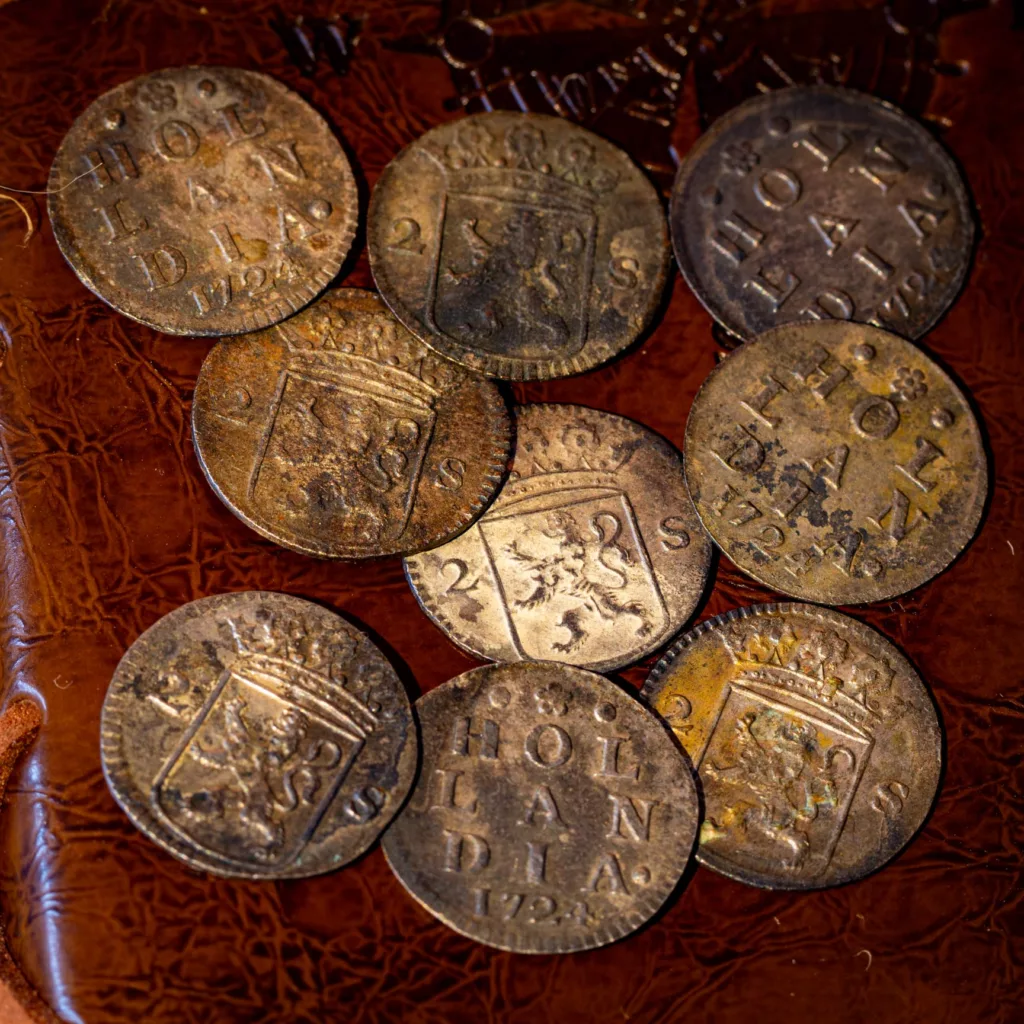
The VOC obtained its payement directly from Dutch mints rather than through private merchants or exchange banks, which rarely held sufficient stock. This is why they had to be specially made by the different provincial mints in the Dutch Republic. In practice, only the mints of Dordrecht, Middelburg, and Hoorn/Enkhuizen were entrusted with these lucrative contracts. Other mints regularly complained to state officials, frustrated at being excluded. As a result they were sometimes granted a commission, but more often this was refused with the remark that ‘the Chinese, being very particular about the payement coins,’ would only accept schellingen and two stuiver coins from Dordrecht and Middelburg.
Incidentally, the combined production was insufficient to cover the total shipments sent out by the VOC. In that case, older schellingen that had been in circulation were also shipped. The Merestein, which sank off the coast of South Africa in 1702, is a clear and till date the only example of this. Almost every type of regular schelling in use at the time was recovered from the wreck, including some specimens that were more than a hundred years old. However, this is the only shipwreck discovered so far that has yielded large quantities of such “old payement,” suggesting that it was not common practice to send coins of lower quality or older issue.
More often, divers have found newly minted payement coins in VOC shipwrecks, originating exclusively from the mints of Dordrecht and Middelburg, which struck coins on behalf of the provinces of Holland and Zeeland. To date, only four shipwrecks worldwide have yielded this type of freshly minted coinage: the Akerendam, Zuytdorp, Slot ter Hooge, and De Liefde. All of them set sail from the Dutch Republic and were lost at sea within a relatively short period, between 1711 and 1725. This may also explain why their lost treasures were relatively similar.
The largest quantity of payement coins was recovered from the Akerendam, which was lost off the Norwegian coast in 1725. Around 30,000 of them were found, consisting mainly of schellingen but predominantly of two stuiver pieces that were both minted in the province of Holland in 1724. This reveals an unequal ratio between the two denominations, which is particularly intriguing. A commonly cited explanation is that while the two stuiver coins were discovered at the main wreck site, about 150 meters from shore, the schellingen were found in very shallow waters closer to the coast, where seabed conditions are much worse. Divers’ reports suggest that many schellingen may still lie buried within the corrosion layers and deposits at that location. Even with a conservative schelling-to–two-stuiver ratio of 1:3, this would imply the existence of several thousand missing coins.
Image of a two stuiver coin recovered from the Akerendam

The Zuytdorp is also known for the many thousands of payement coins recovered from its wreck site. The exact number of coins found, as well as the precise ratio between the different denominations, remains unknown due to large-scale looting by illegal diving expeditions following the wreck’s discovery. However, the online database of the Western Australian Museum, which catalogues all Zuytdorp coins held by the Australian government, likely provides a reliable representation of the ratio among the recovered payement coins. According to this database, the ratio between schellingen and two stuiver pieces—both exclusively minted by the Zeeland mint in 1711—was approximately 1:1.
The freshly minted payement coins recovered from the Slot ter Hooge and De Liefde raise questions among researchers. Both shipwrecks yielded only a very limited number of two-stuiver coins — just a few dozen in total. Excavations at the Slot ter Hooge site uncovered two stuiver pieces minted in Zeeland in 1724, while the De Liefde wreck produced coins of the same denomination minted in Holland in 1711. Notably, no schellingen have been found at either site to date. This absence is remarkable, as it deviates from the standard ratio between schellingen and two stuiver coins typically transported by the VOC.
One possible explanation is that these coins were part of the personal belongings of crew members, which could account for their limited quantity. Another possibility is that contemporary salvage operations successfully recovered the bulk of the payment coins that are now missing. The rarity of the two stuiver coins recovered from both wrecks makes them highly sought after by collectors and among the most valuable examples of their kind.

